

augusta sparks
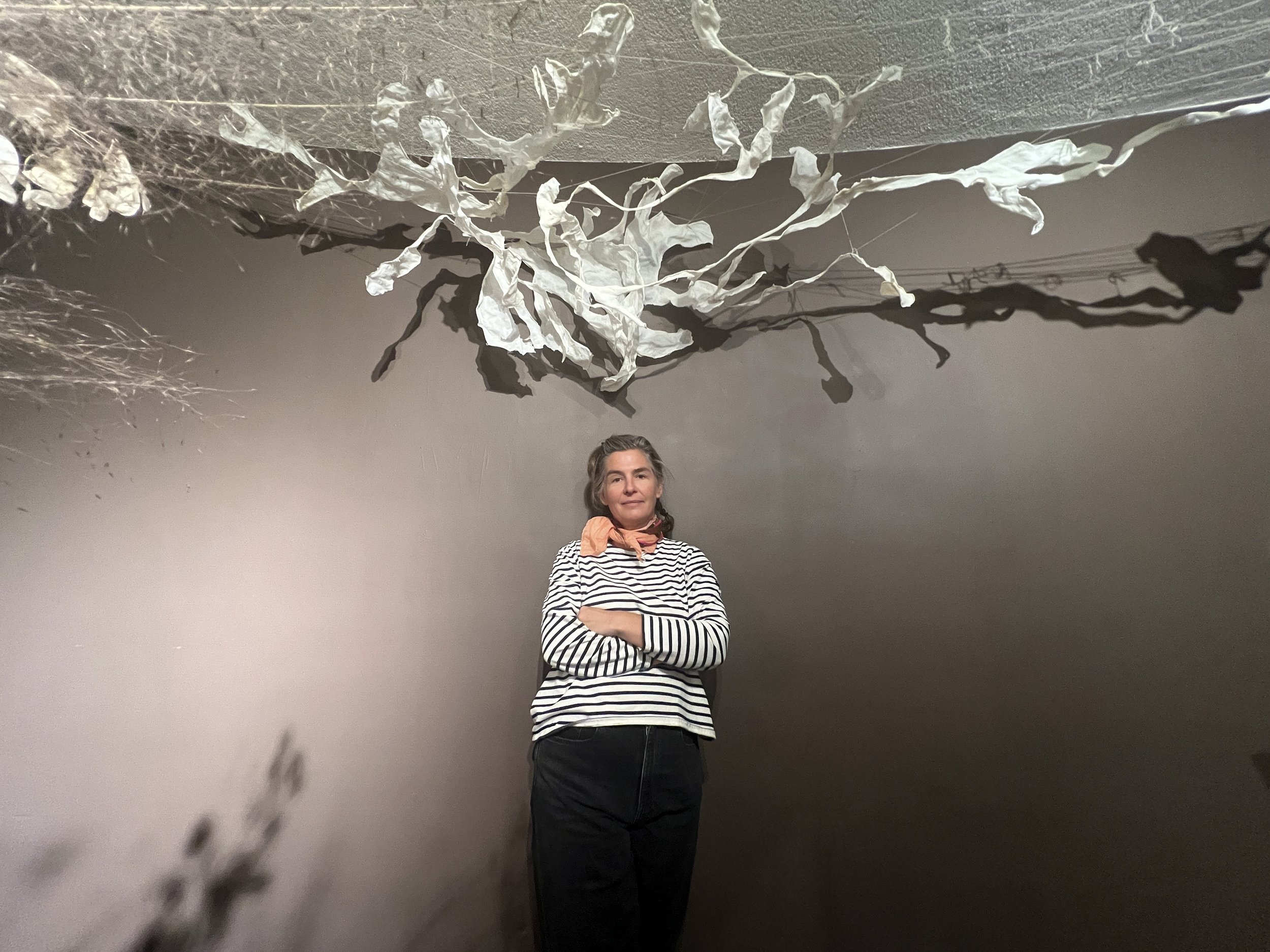
Allowance made for Improvisation — An Installation by Augusta Sparks
softwood cellulose nanofiber, shadow, fingering yarn • 2025
Tumbleweed Found, Santa Cruz, CA
In the tangible, this work responds to the space, to the light moving across the room, and to the presence of her deceased father’s photographs hanging nearby. In Augusta’s words, her practice “navigates grief, destiny, and choice, within a framework of care, control, and curiosity.” The sculpture holds its own center, yet subtly guides the eye into the next room, inviting a quiet dialogue with what
remains.
Suspended in air, the forms appear fragile—almost skeletal, almost botanical—shifting between shadow and light. Augusta works with softwood cellulose nanofiber, a material made of 97% water when wet, yogurt-like in its earliest state. As it dries, transforms, and collapses into itself, it becomes
unexpectedly strong. Scientists at the University of Maine describe nanocellulose as a material that can mimic bone or skin when handled by an artist. Augusta echoes this: “If you look at it closely, the nanocellulose looks like skin or bone… Sometimes it says, ‘Oh, you thought I was done drying? Well,
I’m not, and now I’m going to do this.’”
Her process is one of collaboration with the material—an improvisation between intention and surrender. Each gesture is guided by the way the cellulose stretches, curls, and changes as it dries. In her practice, sense-making is a form of ruminating through grief, a way of listening. What hangs above us is as much emotion as it is form.



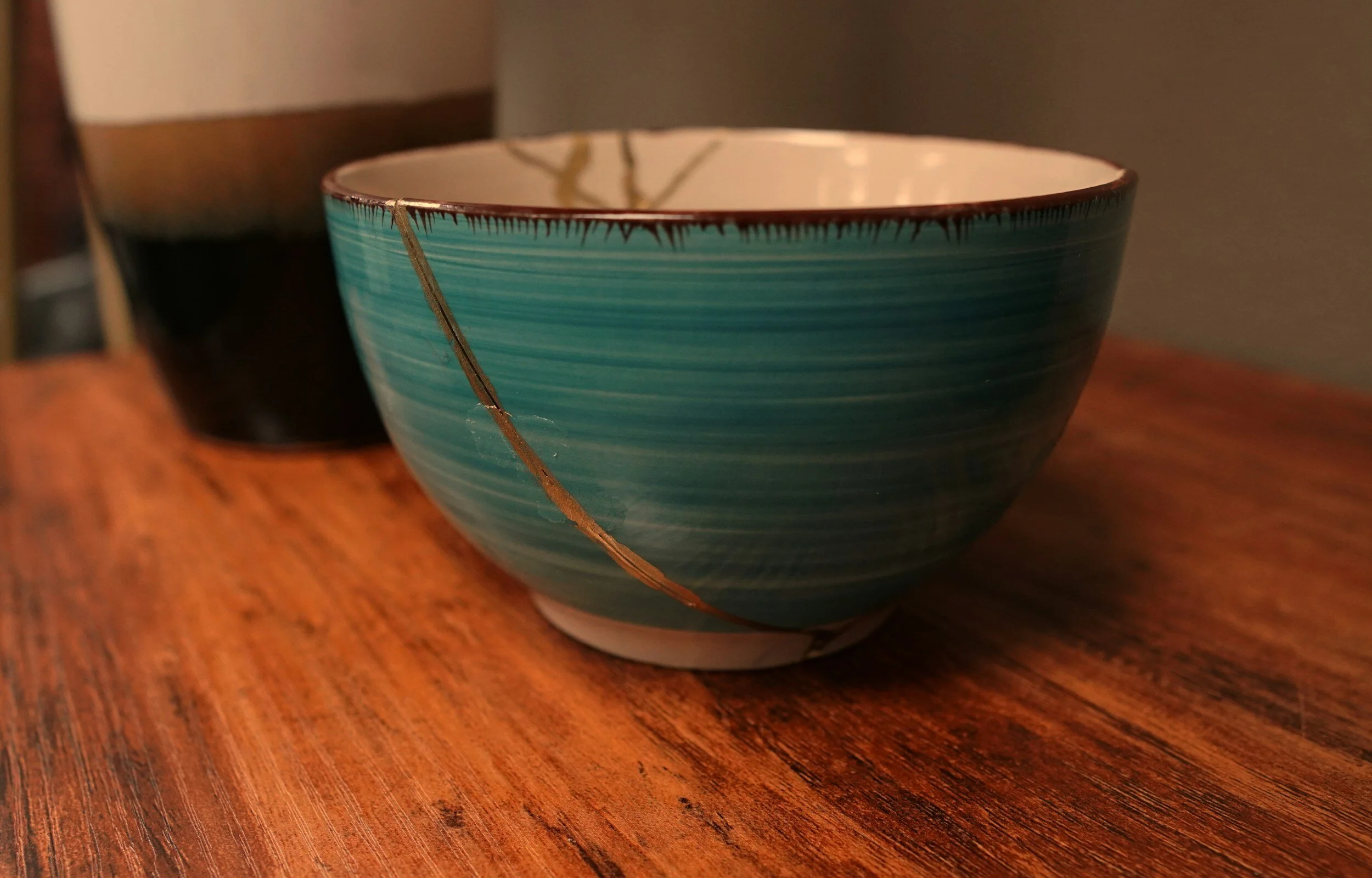
Kintsugi: Broken and Beautiful
Kintsugi means “golden joinery”, also known as Kintsukuroi or “golden repair” is the Japanese art of repairing broken pottery by mending the areas of breakage with lacquer dusted or mixed with powdered gold, silver, or platinum, a method similar to the maki-e technique. The Kintsugi technique treats breakage and repair as part of the history of an object, rather than something to disguise.
Japanese historical sources suggest that a favorite tea bowl of the 8th Ashikaga Shogun, Ashikaga Yoshimasa (1436-1490), had been sent to China for repairs and was returned with metal staples that he found displeasing. It is reported that he ordered a substitute be found and kintsugi was born.
Collectors became so enamored with the new art that some were accused of deliberately smashing valuable pottery so it could be repaired with the gold seams of kintsugi.
In addition to serving as an aesthetic principle, kintsugi has long represented philosophical ideas. Namely, the practice is related to the Japanese philosophy of wabi-sabi, which calls for seeing beauty in the flawed or imperfect. The repair method was also born from the Japanese feeling of mottainai, which expresses regret when something is wasted, as well as mushin, the acceptance of change.
I’m attracted to the symbolism of this beautiful art—taking something broken and highlighting it’s cracks/wounds, emphasizing the broken parts of ourselves and honoring it in gold. As if to say that by doing our “work” we are becoming stronger, more beautiful and whole again.
What does Kintsugi symbolize for you, personally?
I stumbled across a book called Kintsugi Wellness by Candice Kumai. Parts of her documentary are available online to watch, see attached link. Candice opens with, "We all come from broken places. We can take those broken pieces and turn them into something truly beautiful.”
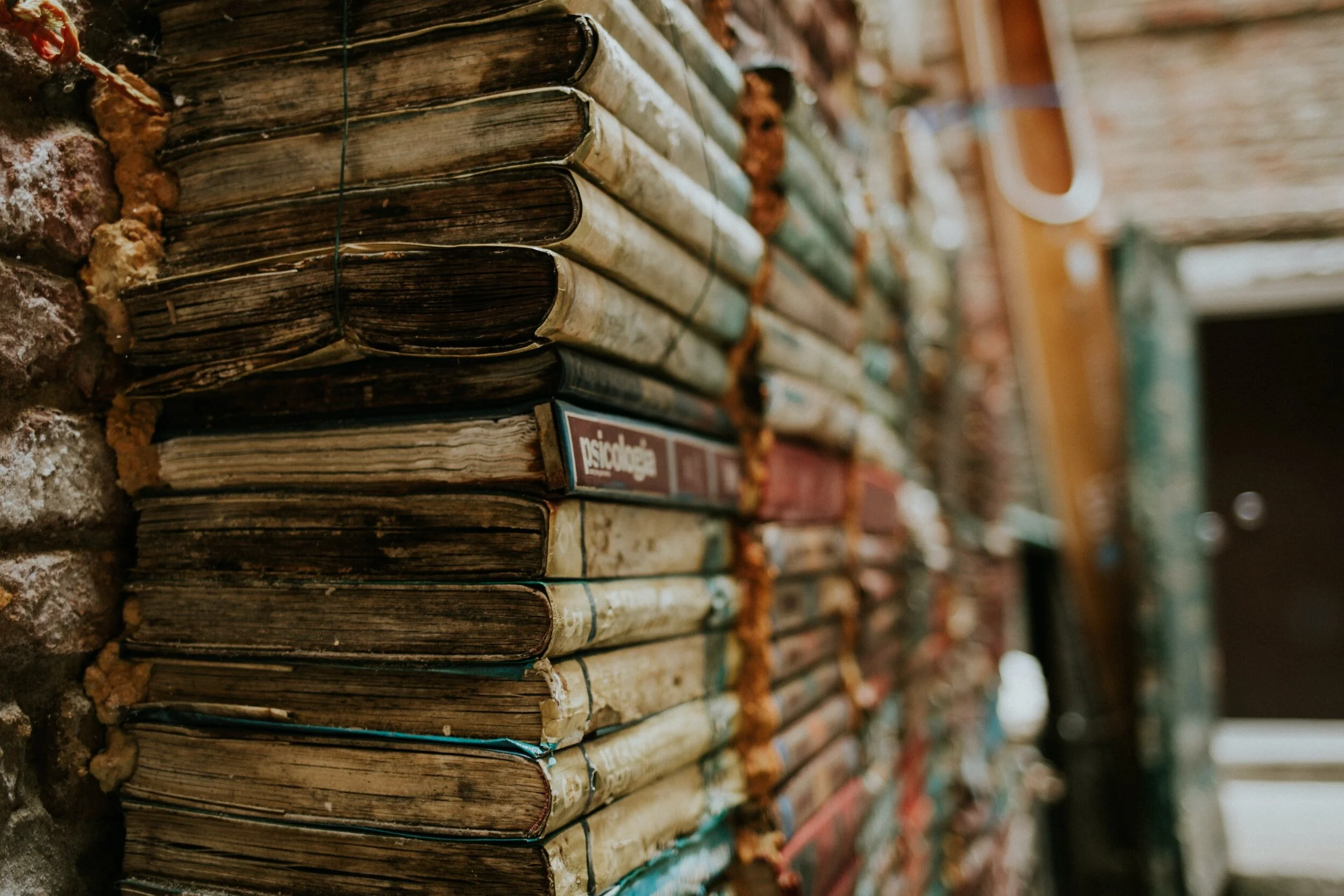
Library of a Lifetime
I recently cleared out the library of an estate. This library was full with a lifetime of books. These books revealed so much about the owner’s interests and passions. The subjects varied from poetry, classic novels, political science, international relations, local history, race and social justice. The earliest book dating back to 1847. I love seeing what’s inside—the date, if it was signed or has a personal inscription and those tucked away notes or newspaper clippings… What an intimate process. In this situation, many books and papers were donated to organizations and colleagues that shared the same profession and work. We are selling the remainder of the books. Please inquire if you are interested in getting a preview.
It makes one think, does my library represent me and my interests? What will my family learn about me through my books, when I go.
When a family member or loved one passes, spend time with their books, if you can. Be with what interested them. Learn more about them through the variety of subjects, sitting on their shelves. You can preserve their library by typing a list of their books for you and generations after you to remember what interested them (you could even note personal inscriptions).
While it’s not practical to keep every book, consider keeping a few and passing along others-Are there any books that intrigue you?, that make you want to learn why it was important to your loved one? Do you know someone else in the family that would? (gift it with an inscription like, “from the library of your Grandma Clara Olson(1924-2016)”. Gift them to friends that share similar interests. Donate them to an organization, museum, historian, researcher, writer or your local library.
In your own home—type up a booklist of what’s on your child’s book shelf at different stages of their life—what are their favorite childhood books? What books were on their bookshelf before they left home? Were any books gifted from family (how were they inscribed)?
When you’re purging your personal library, type up a booklist of the books you’re letting go of so you remember them and can refer to them while making room for new book interests.
1. The Giving Tree by Shel Silverstein(1964)
2. The Case of Sacco and Vanzetti by Felix Frankfurter(1927)
3. A Farewell to Arms by Ernest Hemingway (1929)
4. Ex-Wife by Johnathan and Harrison Smith(1929)
5. She’s Tricky Like Coyote by Lionel Youst (1997, signed)
6. The Well of Loneliness by Radclyff Hall (1928)
7. The Occasional Speeches of Justice: Oliver Wendell Holmes by Mark DeWolfe Howe (1962)
8. Point Counter Point by Aldous Huxley (1928)
9. Boss Ruef’s San Francisco by Walton Bean (1967)
10. Little Journeys by Elbert Hubbard (1897)
11. In Flander’s Fields by John McCrae (1919)
12. Black Metropolis by St. Clair Drake and Horace R. Cayton (1945, signed)
Send us a dm if you’re interested in any of the books above.
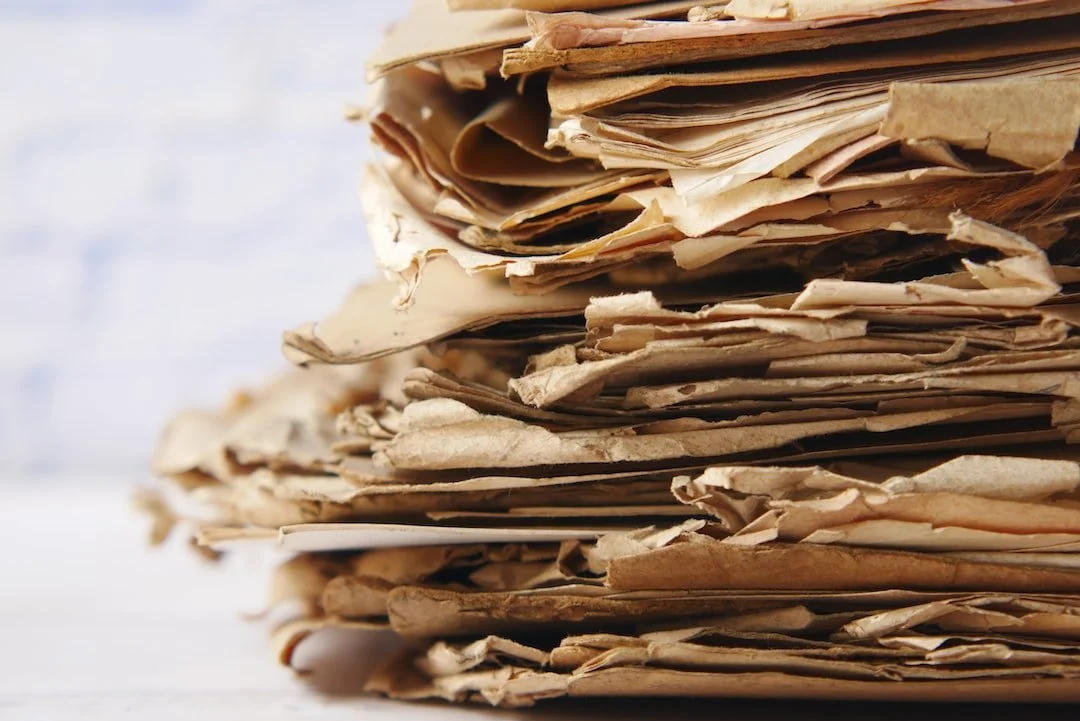
Pages of the Past
I have unquenchable thirst for family history. Give me a mystery and I’ll dig to all corners of the earth for the answers. The hunt--full of timelines, relationships, questions and "trying on” possibilities. The rewards, so satisfying or suspended in mystery.
Often, I go looking so hard for one person and find another person or path.
I was contacted by a genealogist that was working for a family, a descendent of a common ancestor. He wanted to know if I want to research with him. So, the magnifying glass went to this branch of the tree and it’s descendants….Ben Olson is my Great Great Grandfather on my maternal side. I won’t geek out too hard on you, I’ll keep to basic information. Ben and Clara married in MN and for unknown reasons Ben left and lived in a nearby town as a bartender (listed single) while Clara (listed as married) lived with his family and their baby Hilda. I don’t know what happened to Clara. Hilda was given to family in Lake Preston, SD to be raised. I was hoping that tracking Ben would give me more information about Clara and Hilda but, instead I learned about Ben’s suicide and his brother Eugene’s murder.
Ben moved from Minnesota to North Dakota and then to Canada where he joined his brother Eugene fur trapping. For unknown reasons they split up and trapped different areas. In 1930, Eugene and his partner were murdered in their cabin on the Thelon River, in the Northwest Territories.
Fascinated by this life of solitude and harsh conditions, I found a book on Ebay that was written about a man interviewing a Canadian trapper that would’ve been alive during the same time period. I got to better understand the landscape, the trade, the beauty and the intensity of this chosen career. I let out a scream when the author mentioned the known murder of my great great uncle and his partner. I got ahold of newspaper articles, Canadian Mounted Police reports and death certificates. I found a kayaking company that does excursions up the river where they died. They wanted to know all the facts so they could honor and correctly pass on their history to their tours. They blessed me with photos of the man-made grave. There were a theories about who murdered them—Albert Johnson AKA the Mad Trapper of Rat River or Inuk Tekaluk. The trappers left a journal that was an important part of the investigation. I recently contacted the RCMP Historical Collections Department to see if any items, including the journal are at a museum or available to view. I love inscriptions of a book, sometimes more than the book itself. To see handwriting, dates, dedications…I’ve learned it’s worth the ask even if it feels like a long shot. It’s on my bucket list to go on that kayak trip, too. To see the land, to feel the stories of my ancestors and to weep for the loss of family.
At the age of 58, Ben committed suicide (1935) near Beaver River, N. British Columbia. He was found by a visiting friend and fellow trapper. No journal, no explanation. I can only imagine that it was a hard life and that the isolation and remoteness got to him. A newspaper article shows there was a 300 mile trek by Provincial Police to investigate. So many questions...
I continue to research this part of my family. I search for postcards, photos, trapping books, maps and objects of the time to learn, understand and remember them. I honor them by passing on their stories and having these objects around in my home. My home is my nest of memories, family history and inspiring objects.
The new suicide and crisis lifeline can be reached by text or calling 988

Navajo Spirit Line
Navajo weavings are complex, beautiful, time-intensive artwork made from natural dyes that are full of symbolism and tribal history.
I recently learned about the “Spirit Line” from one of my wise old mentors. When the Navajo weaver works on a weaving, she puts her soul, energy and spirit into it.
Sometimes you will find a ch’ihónít’i, also known as a “spirit line” or “spirit pathway” on a Navajo rug. This is a thin line which extends from the center of a Navajo rug across the border to the outside edge or is sometimes placed near a corner and made of the same color as the background of the field.
Navajo believe that when weaving a rug, the weaver entwines part of her spirit into the rug. The spirit line prevents the weavers spirit from being trapped and allows weaver's spirit to safely exit the rug.
The belief is that the energy and spirit woven into the rug must be released so the weaver will have the energy and spirit to continue weaving other rugs.
This intentional and sacred line should not be mistaken as a flaw. I now look for it, pause and honor the weaver’s work and her freed spirit that brought so many generations of weavings.

Coins…With His Hands and Ashes
I was reminded of this song when Interviewing my friend Richard. We were both sharing how we loved worn objects. Like old religious items worn smooth. “It’s a wonderful feeling. Someone held onto them for years. And like a coin, how much energy went into making it smooth.”
The Jeweller by This Mortal Coil (written by Tom Rapp)
Jeweller has a shop on the corner of the boulevard.
In the night, in small spectacles he polishes old coins.
He uses spit and cloths and ashes.
He makes them shine with ashes.
He knows the use of ashes.
He worships God with ashes.
The coins are often very old by the time they reach the jeweller.
With his hand and ashes he will try the best he can.
He knows that he can only shine them, cannot repair the scratches.
He knows that even new coins have scars so he just smiles.
He knows the use of ashes.
He worships god with ashes.
In the darkest of the night.
Both his hands will blister badly.
They will often open painfully and the blood flows from his hands.
He works to take from black coin faces, the thumb prints from so many ages.
He wishes he could cure the scars.
When he forgets he sometimes cries.
He knows the use of ashes.
He worships god with ashes.
He knows, He knows
He worships God with ashes

Archeological Relief Rubbing by Merle Greene Robertson
When I was very little my grandparents gave me a tape recorder. I taped everything from my grandpa playing the guitar and singing to conversations in their house. I loved to interview my grandparents. I wanted to know all their old stories, music and jokes. My love for family history research grew as I learned about more of the family characters. Solving family history mysteries and figuring out timelines have always been so rewarding to me. Researching found items have a very similar reward.
What an incredible story unfolded from an art piece that passed through me—an ARCHAELOGICAL RELIEF RUBBING BY MERLE GREENE ROBERTSON
The original archaelogical rubbing by famed scholar Merle Greene Robertson was created by her in 1993. This is a close up detail with it’s beautiful paper and ink.
It came to me in excellent condition on rice paper, mounted, matted in linen face board and framed. Signed and dated. Overall with frame approximately 66” x 17.75”. Rubbing 58” x 11.25”. A dramatic horizontal rubbing.
Mrs. Robertson was a leading researcher of ancient Mayan civilization and a passionate teacher who led hundreds of local students on adventures amid the ruins of Central America and Mexico. She pioneered a type of archaeological rubbing, using Japanese rice paper and ink, that elevated the standard technique for recording images artifacts to an art form. For the rubbings, she would clean the artifact, then cover it with wet rice paper. When the paper dried, she meticulously blotted it with ink until she created a perfect impression of the of artifact. Rubbings are superior to photographs or drawings because they’re 100 percent scale, can be three-dimensional and contain no shadows. More than 2,000 of her rubbings are preserved at Tulane University in New Orleans. In 1983, the Mexican government honored her with the highest award it bestows on foreigners, the Order of the Aztec Eagle, for her years of helping preserve Mayan heritage. There are many fascinating books about her research work, rubbings, awards and photos—A fascinating woman and such a rare glimpse of history in art form.
The rubbings of Merle Greene Robertson, which are noted for their accuracy, are considered the finest anywhere. Best represented are the Classic sites of Tikal, Kaminaljuyu, Santa Lucia Cotzumalhuapa, Tazumal, Palenque, Chinikiha, Yaxchilan, Bonampak, Picdras Negras, Uaxactun, Chichen Itza, Uxmal, and Dzibilchaltun. All of them have been done with the written permission of the Mexican, Guatemalan, Honduran, Belizian, and Salvadoran governments.
Two important developments in the area of Maya studies gave this project a sense of urgency. One has to do with the explosion of knowledge about the political history of the ancient Maya. New archaeological data, including the discovery of new sculptured monuments in Mexico, Guatemala, and Belize, as well as recent advancements in the decipherment of the Maya hieroglyphic script, have greatly increased our understanding the processes of ancient Maya civilization. Questions about the roles of warfare and environmental destruction to the demise of the large centers in the tenth century relate directly to the problems of today. The other reason for urgency in recording and preserving monuments has to do with the continuing destruction of Maya archaeological remains. It is a race against time to record them due to deliberate loss through theft and vandalism, as well as the natural ravages of time. The average rate of destruction of limestone by normal wear is about to 4 mm in 50 years, or roughly, 1mm every 12years. In addition, jungle growth-plants, bacteria, and algae-takes its toll. It can cover the monuments and send plant roots into the cracks and crevices. These in turn break up the sculpture.
Merle Greene Robertson recorded the Maya Archival Database Project of rubbings from 1962-1993. These CD ROM disks contain over 1200 rubbings of Classic Maya monuments from over 80 sites. At the time this rubbing was made, in 1993, the archive was just published. They were still other works/rubbings that they were working on from Chichen Itza and other sites. I do not know the specific site or project that this particular rubbing came from. It’s rare to see or own one of her rubbings. It was a very special piece that I had the honor of seeing, researching and finding a new home for.